Memory
Preserves context and institutional knowledge.
web4intelligence.org · canonical thesis site
The fourth internet era is defined not by what users can read, write, or own — but by what they can delegate. Structured, governed, accountable handoffs of intent to intelligent agents operating on your behalf.
A necessary distinction
The individual delegation layer: you → agent → outcome. A single, bounded, accountable handoff of intent and authority. The unit of interaction is the delegation contract.
The collective layer: many agents → shared knowledge → adaptation. Emergent sense-making across delegations at ecosystem scale. Web4 must exist before Web5 can function.
From thesis to formal vocabulary
A delegation is only accountable if both sides agree on what was delegated. That agreement needs a shared, machine-readable vocabulary — the ontology layer that turns the Web4 primitive into interoperable contracts agents can actually execute.
jsontology.com
The JSON-native schema and validation layer for delegation contracts — the implementation surface of the Web4 ontology.
Explore the ontology →
agentontology.org
The formal vocabulary for agent interoperability — glossary, patterns, and delegation models that ground the thesis in specification.
Read the spec →
Essays
All essays →2026-07-16
You cannot delegate to an entity that has no address. Before AI agents can participate in the economic and social infrastructure of the internet, they need a stable identity layer — one that is persistent across sessions, verifiable by third parties, and portable across platforms. This essay argues that agent identity is not a privacy feature or a product differentiator. It is the foundational prerequisite for the trust stack that Web4 requires.
2026-07-10
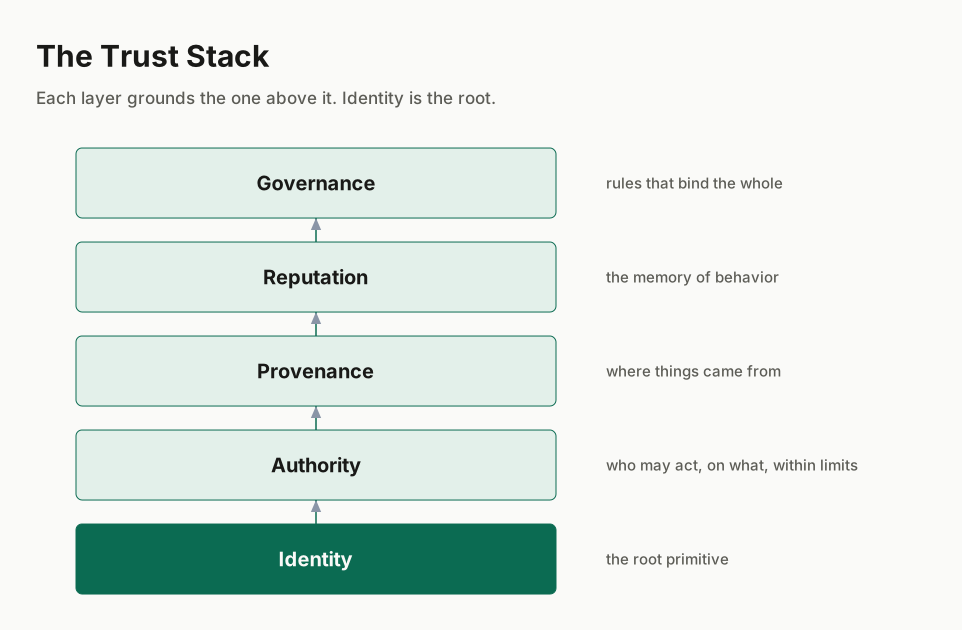
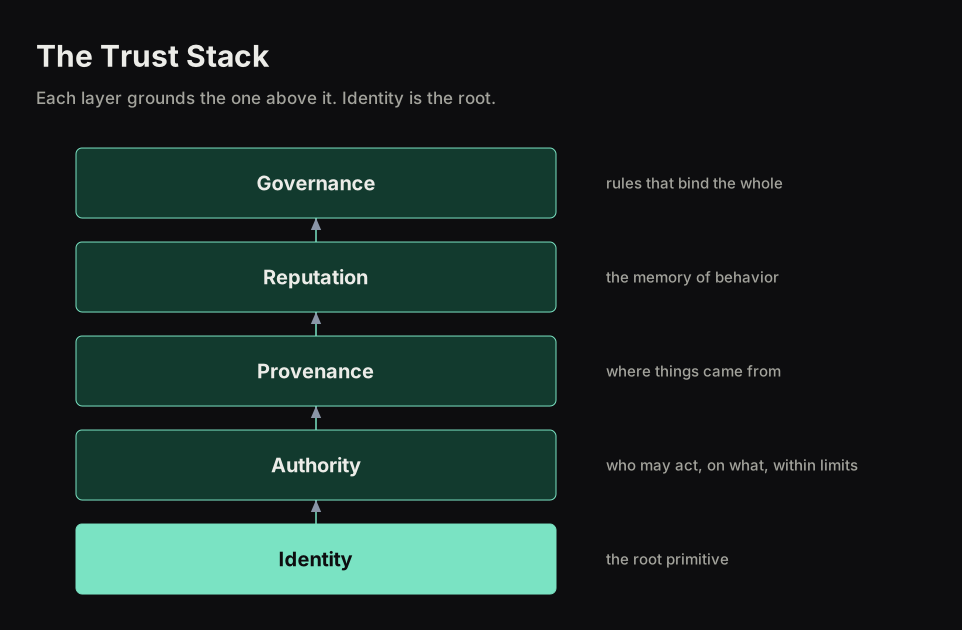
Delegation without trust infrastructure is abdication. This essay maps the five layers that must exist before any meaningful delegation can happen at scale — identity, authority, provenance, reputation, and governance — and argues that most current AI infrastructure builds only the capability layer while leaving the trust stack entirely empty.
2026-07-04
Every internet era has a defining primitive — the smallest unit of interaction from which everything else is built. Web1's primitive was the hyperlink. Web2's was the engagement signal. Web3's was the token. Web4's is the delegation — the structured handoff of intent and authority from a human principal to an intelligent agent. This essay argues that getting the primitive right determines whether the Web4 era fulfills its potential or collapses into a new form of platform capture.
Intelligence architecture
Preserves context and institutional knowledge.
Transforms information into insight.
Synchronizes people, agents, and workflows.
Improves capability through feedback.
Responds to changing environments.
Enables ecosystem-scale learning.
Trust architecture
Core functions
WEB4-024
WEB4-024 explains how trust earned in one context can be interpreted by another system without collapsing identity, provenance, evidence, or local judgment.
Federation model
Agents reuse earned trust only when identity, task scope, provenance, and model context remain interpretable.
Citation, review, dataset, method, and institutional trust can be interpreted across knowledge systems.
Stewardship, audit, appeal, and participation history can travel through governed trust domains.
Trust signals move across people, organizations, vehicles, agents, and long-running operations.
WEB4-026
WEB4-026 frames intelligent ecosystems as governed networks of human, AI, organizational, institutional, and robotic agents.
Autonomous agents coordinate through identity, authority, trust, provenance, and escalation rather than isolated local decisions.
Human researchers, review agents, datasets, registries, and institutions preserve claims, evidence, judgment, and revision.
Clinicians, care agents, hospitals, payers, devices, and governance bodies coordinate without losing responsibility.
Space and robotics missions coordinate many autonomous and human actors through shared governance protocols.
WEB4-027
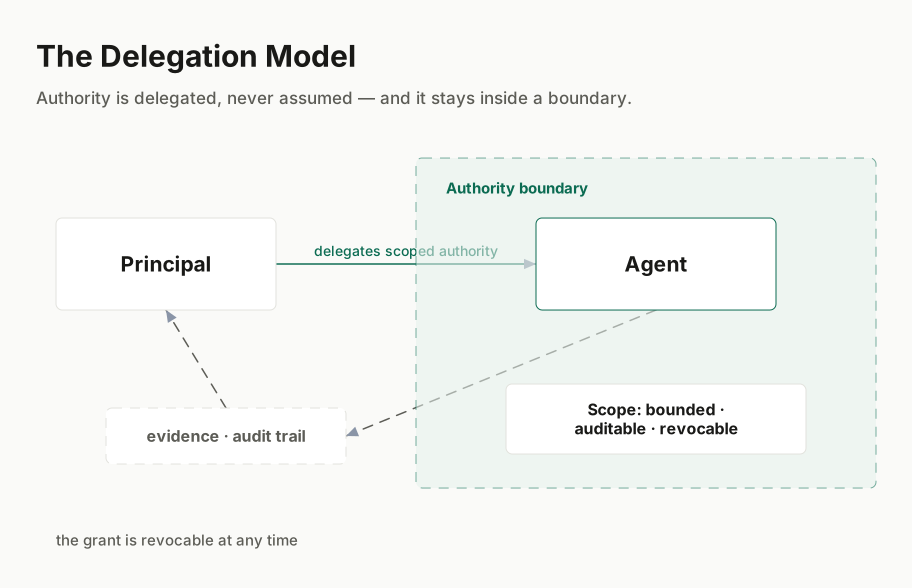
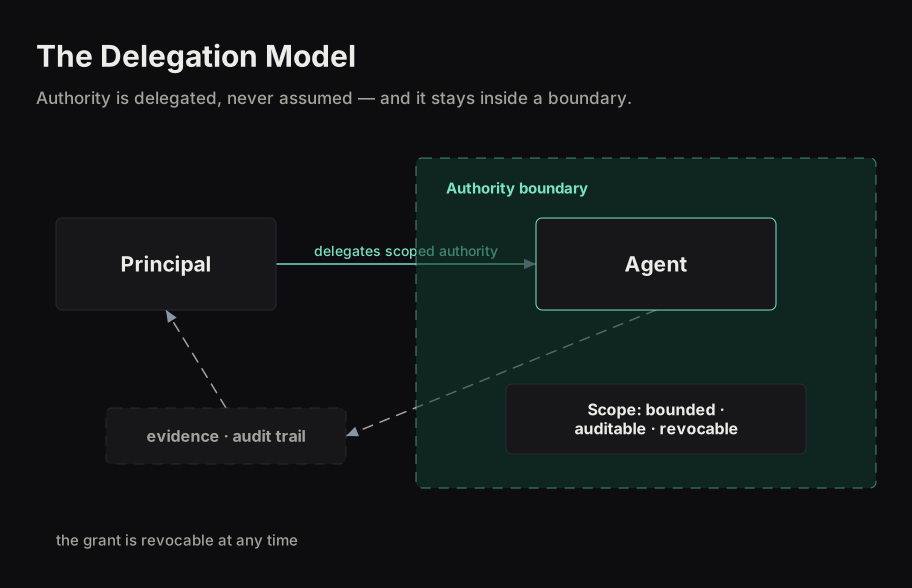
WEB4-027 constrains intelligent capability with identity, authority, verification, escalation, auditability, and revocation.
Preserves citation, evidence, uncertainty, contradiction, review state, and supersession.
Separates recommendation from clinical authority while preserving consent, evidence, and escalation.
Carries role-specific authority boundaries for recommendation, approval, payment, and execution.
Combines autonomy with mission authority, contingency escalation, stewardship, and auditability.
Canon references
Intelligence Canon
web4intelligence.org owns this subject-matter collection while web4research.org remains the master canon library and canonical source.
Intelligence as Infrastructure argues that reasoning, memory, learning, adaptation, orchestration, agents, and micro-models become reusable infrastructure layers.
Truth, Claims, and Verification defines the Web4 treatment of truth claims, evidence, verification, judgment, contradiction, revision, supersession, and appeal. It argues that in intelligent systems, truth is not merely asserted; it is claimed, evidenced, verified, contested, judged, revised, and remembered.
Portable Trust Networks defines trust portability across identities, organizations, registries, institutions, ecosystems, and intelligent agents. It explains how trust earned in one context can be evaluated, interpreted, transferred, and reused in another.
Multi-Agent Governance defines governance when many agents, humans, organizations, and institutions interact simultaneously. It describes ecosystem governance across human-agent, agent-agent, organization-agent, institutional, and robotic agent contexts.
The Constitutional Agent defines the implementation model for constitutionally-governed agency: an agent carrying explicit constraints, authority boundaries, escalation obligations, stewardship duties, auditability requirements, verification requirements, and revocation mechanisms.
Authority Network
Move across the authority sites without losing web4research.org as the master library.
The stake in the ground
"Web4 is the era defined by delegated intelligence as the dominant internet primitive."
This definition is falsifiable. We offer it not as final truth but as a coordinate — a named position that lets researchers, builders, and investors orient relative to a specific claim.
Follow the thesis
Direct to your inbox — no weekly roundups, no growth hacks. One email per essay, one email per major thesis update. Beehiiv wiring in progress.
Web4 thesis cluster
web4research.org
Publication and academic layer — whitepapers, citations, and studies underpinning the Web4 canon with research credibility.
web4asean.com
ASEAN-focused Web4 regional brand leveraging Cebu base as credible geographic anchor. Events, partnerships, and regional media for the fastest-growing digital economy.
These domains form the Web4 thesis cluster — web4intelligence.org is where the full thesis lives.